

Do you need sunscreen every day, even if your makeup has SPF?
For everyday sun exposure, including the commute, make broad-spectrum SPF 30 or higher part of your morning routine.
Makeup with SPF can contribute protection, but the amount and coverage people normally apply may not deliver the protection on its label. Apply sunscreen before makeup, follow its directions, and reapply at least every two hours outdoors. Clouds do not eliminate UV exposure.
Daily protection also belongs at the foundation of a plan for sun-damaged skin, although it cannot replace assessment or treatment of existing changes.
The discipline you bring to business belongs in your skincare routine
You can build a business with extraordinary discipline and still leave home without protecting your skin. You can understand the value of preparation, follow-through, and decisions that pay off over years, while treating sunscreen as something reserved for a beach bag.
After treating thousands of guests, I have noticed this disconnect. People who would never expect one meeting to build a company sometimes hope one facial will resolve concerns that have developed over time. They are willing to invest in care. The daily habits around that care are less established.
It is easy to understand why. A facial is an appointment. It has a place in the calendar, a professional guiding the experience, and an immediate sense that you have done something for yourself. Morning sunscreen can feel ordinary by comparison. There is no meeting invitation reminding you to apply it before leaving for work.
That is where I believe the useful conversation begins. Knowing that a habit matters and making room for it are separate tasks. In business, we build systems around the behaviors we want to repeat. Personal care deserves the same practical attention.
For the professional heading to an office and the woman carefully applying her makeup, the underlying question is similar: have you built protection into the day, or are you assuming something else has already taken care of it?
Does daily sunscreen make a difference over the long term?
Yes. A randomized Australian trial published in Annals of Internal Medicine examined photoaging in 903 adults younger than 55.
After approximately four and a half years, the daily sunscreen group had lower odds of progression in the study's measured skin-aging outcome than the group using sunscreen at its discretion: relative odds 0.76, or about 24% lower.
That number needs careful interpretation. It does not mean participants became 24% younger, that every wrinkle disappeared, or that any particular commercial sunscreen will deliver an identical result. The trial evaluated a defined outcome in a particular population; some outcome data were missing. Its useful finding is that regular protection produced a measurable difference over years.
For me, this is the most persuasive bridge between skincare and the way thoughtful people approach their work. An everyday action can matter even when its value is difficult to judge after a single morning. You do not need a dramatic before-and-after photograph each week to justify a protective routine.
Skin also changes with age, genetics, health, and other influences. A face is never a scorecard for someone's discipline or character. The point of consistency is to support your future wellbeing with the decisions available to you today.
Myth: “My foundation has SPF, so I can skip sunscreen”
Makeup can contain a legitimate SPF. The practical limitation is often how it is used. In the United States, makeup products that also claim sun protection are regulated as both cosmetics and drugs. It would be inaccurate to suggest that SPF in makeup is automatically meaningless.
But a product's labeled protection and the protection achieved by a light application are different questions. University Health explains that people generally do not apply enough foundation to obtain its full labeled SPF. Concealer applied to selected areas also leaves the rest of the face uncovered.
This matters particularly for women who have invested in a makeup routine and reasonably expect a premium product to do everything its packaging suggests. The brand name does not tell us how evenly it has been applied. The purchase price does not tell us whether the ears or neck have been protected. A beautiful finish and adequate sunscreen application are separate responsibilities.
Should sunscreen go before or after makeup?
Apply sunscreen as the final step of morning skincare, before makeup, and allow it to settle according to the product's instructions. Then apply foundation or concealer. Keep the products separate: mixing sunscreen into makeup can compromise the protection you expect from the original formula.
A lightweight texture can make this sequence easier to live with. That is a useful reason to choose a formula: it fits the way you actually get ready. You should not have to choose between feeling comfortable in your skin and remembering to protect it.
The same principle applies if you wear no makeup at all. The sunscreen step still has its own purpose. For people who do wear makeup, the practical goal is a routine that accommodates protection without turning every morning into a complicated project.
Myth: “It is cloudy, and I will be inside an office”
Clouds can reduce UV, but they do not reliably eliminate it. UVA can also pass through ordinary window glass. That makes a commute and time spent close to a window relevant to a person's exposure, even when a beach visit is nowhere on the schedule.
Context matters. A desk deep inside a building is different from a chair beside a large window receiving daylight. Glass treatments, distance, and time in the light affect the situation. The point is to consider your real day instead of using the word “indoors” as a complete description of it.
My earlier article about sunscreen in winter explored why people associate protection with the feeling of heat. Here in Miami, that assumption can carry into air-conditioned routines: the drive, the lobby, the office, the walk to lunch. Feeling cool tells you about comfort. It does not measure UV exposure.
What is the UV Index in Miami?
There is no single Miami UV Index that applies every day. The forecast varies with conditions and the time of year. The Environmental Protection Agency explains that the calculation accounts for factors including the sun's angle, ozone, clouds, and elevation. Check the current forecast for your location through the EPA's UV Index resources.
Florida's relatively low latitude helps explain why sun protection deserves attention, but a geographical label cannot replace today's conditions. Use the forecast to plan shade, clothing, and outdoor timing. Keep your morning routine easy enough that it does not depend on remembering to debate the weather every day.
What SPF should you use in Florida—and is SPF 100 better?
The American Academy of Dermatology recommends broad-spectrum SPF 30 or higher and water resistance. Broad-spectrum coverage addresses both UVA and UVB. For swimming, outdoor exercise, and sweating, check the water-resistance directions as carefully as the SPF number.
Higher SPF can provide additional sunburn protection. In a randomized, double-blind study of 199 adults during outdoor recreation, SPF 100+ outperformed SPF 50+ under the conditions tested. Participants wore one sunscreen on each side of the face. The study assessed a single day's exposure and was funded by Johnson & Johnson Consumer Inc.; several authors had industry affiliations.
That finding does not establish that SPF 100 is the best choice for every person, nor does it directly compare every SPF 70 and SPF 100 product. It does show why dismissing all higher-SPF products as useless would be too simplistic.
Equally, a larger number does not remove the need for sufficient application or reapplication. There is no waterproof sunscreen. Water-resistant labels specify 40 or 80 minutes under swimming or sweating conditions; follow the directions and reapply after toweling. Choose a product you can use correctly for the activity ahead.
What facial treatment is best for sun damage?
There is no single best facial for every kind of sun damage. Consistent sun protection is the foundation; the right treatment depends on what needs attention. The phrase “sun damage” can describe changes in pigmentation, texture, or lines, and it can also be used casually for a spot that has never been medically assessed.
When someone asks me for the best facial for sun-damaged skin, I want to understand the routine surrounding that appointment. What happens between visits? How is the skin feeling? Which products are being used? What does an ordinary day outdoors look like? Those answers make the discussion more useful than selecting a treatment by its name alone.
Sunscreen is not a facial and does not erase all existing damage. Dermatologists may use prescription topical treatments, selected chemical peels, lasers, or other procedures for particular concerns. These options require an appropriate assessment and carry different considerations for different skin types.
What is the best facial treatment for sunspots?
Start by finding out whether the spots are actually sunspots. The American Academy of Dermatology advises a dermatologist's examination before treating age spots because other conditions can look similar. A new, changing, bleeding, or persistent suspicious mark deserves medical attention before a cosmetic appointment.
At LUX MedSpa Brickell, our customized facials in Miami begin with a conversation about the skin's current condition, comfort, barrier, and goals. Depending on suitability, a facial may focus on hydration, cleansing, or carefully selected exfoliation. A spa consultation supports cosmetic care; it does not diagnose a lesion or replace dermatology.
My advice is to build daily protection into the plan before expecting an occasional treatment to carry the whole responsibility. You can value a well-chosen facial and give equal attention to the ordinary mornings that follow it.
The best sunscreen brand is one you can use consistently
People often ask which brand they should buy. My first question is whether they already own a suitable sunscreen they are willing to wear. An effective routine does not need to wait for a new order to arrive.
There are practical conditions: use an in-date product with appropriate broad-spectrum protection, follow its directions, and choose water resistance when needed. Storage matters, too. The FDA advises protecting sunscreen from excessive heat and direct sun, and replacing expired products. A bottle repeatedly left in a hot car deserves attention, regardless of its price.
If the sunscreen you have meets your needs and feels comfortable, use it. If it stings, feels unpleasant, or makes you avoid the routine, look for a suitable alternative instead of abandoning protection. Finding that fit is a practical decision, not a competition to own the most expensive bottle.
I share what I use because guests ask and because transparency matters. That recommendation should leave you better informed and free to choose. The habit is more important than loyalty to my shelf.
From the final step of our facial protocol to a habit at home
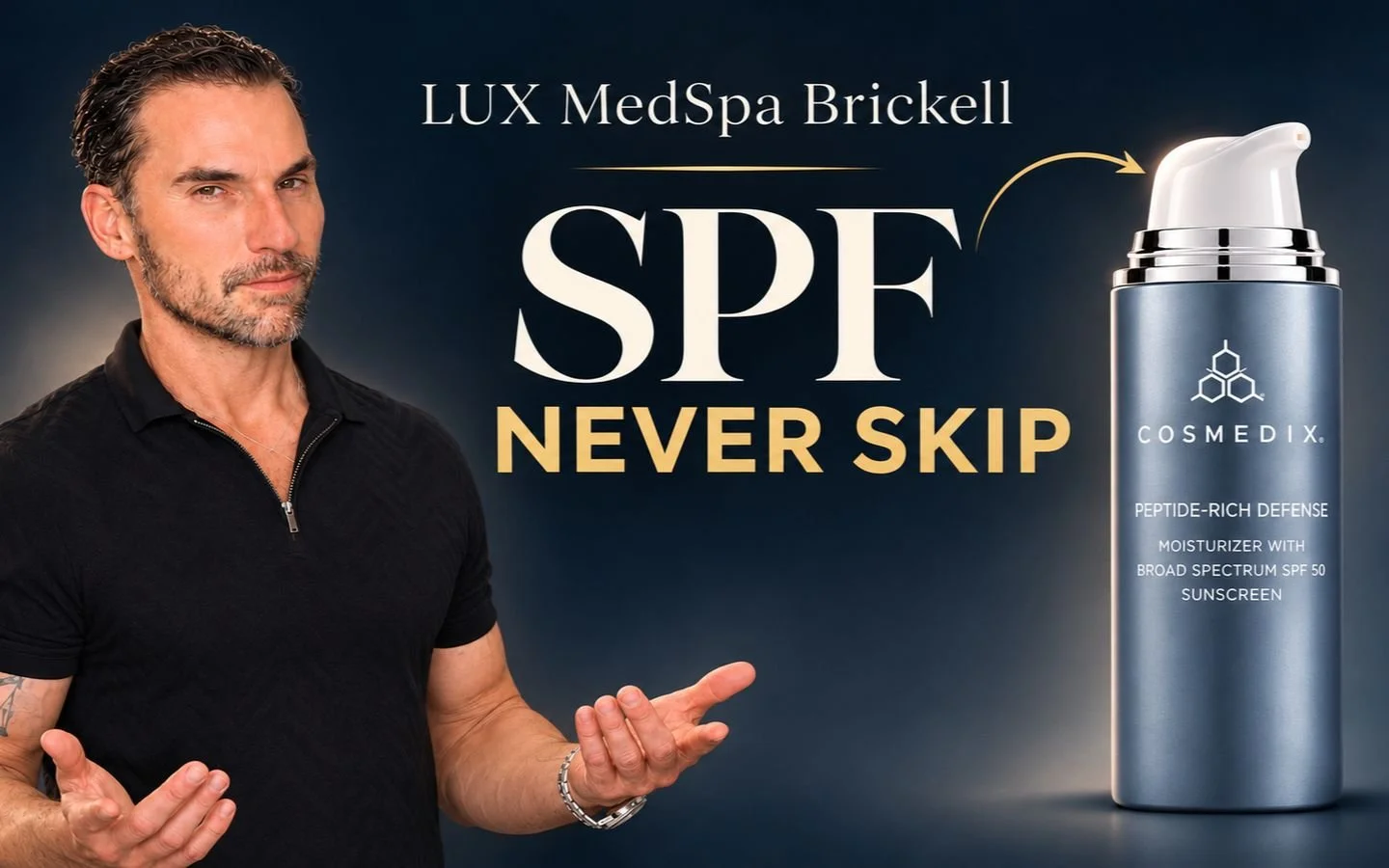
In my short video, you see me dispense two pumps of COSMEDIX Peptide-Rich Defense SPF 50 and apply it to my guest as the final step of the facial protocol. It is a small moment from the treatment room, with a message I want guests to carry into the next morning.
The product combines moisturizer and broad-spectrum SPF 50 in a lightweight formula that can be worn before makeup. You can read its details and directions on our Peptide-Rich Defense SPF 50 page. LUX MedSpa Brickell sells this product; this article's general advice applies beyond that commercial relationship.
The two pumps describe what is shown in that particular video. Pump output varies, so a count is not a universal dose for every sunscreen or every area of skin. At home, follow the product label and apply generously to exposed areas. A short demonstration should reinforce the habit without becoming a substitute for complete directions.
How to make daily sunscreen a habit that survives a busy week
Start by making the decision easier to repeat. Keep your sunscreen beside the products you already use in the morning. Give it a clear place in the sequence. Check whether the formula works comfortably with your moisturizer and, if you wear it, your makeup. These are practical ways to remove obstacles from a routine.
Think through the day before you leave. An office morning followed by an outdoor lunch needs different preparation from an uninterrupted day away from windows. A workout, pool visit, or boat trip calls for appropriate water resistance and a plan for reapplication.
For this product, the directions specify application 15 minutes before sun exposure. When outdoors, reapply at least every two hours; follow the label for swimming, sweating, and towel drying. Shade, protective clothing, and a hat help complete the plan. A makeup routine needs to accommodate reapplication when exposure continues.
If you miss a morning, return to the routine at the next opportunity. There is little value in turning a lapse into a judgment about yourself. Build something workable, pay attention to what makes you skip it, and adjust.
In business, I appreciate systems that keep useful actions from depending on motivation. In skincare, I appreciate a routine a guest can realistically maintain after leaving the treatment room. Both begin with understanding the person who has to do the work.
What you do when no one is watching eventually becomes what everyone sees.
For me, that thought is a reminder to give private acts of care the attention they deserve. You do not have to earn the right to care for yourself by finishing every task first. Make space for a simple protective habit now, while its value is still something you are building for the future.
If sunscreen is not part of your routine yet, start with a suitable product you have. If the habit is already established, keep going.
Sunscreen, makeup, and sun damage: common questions
Is makeup with SPF enough if I only go to the office?
Usually, a typical makeup application is not a dependable substitute for a full sunscreen application. Consider the commute and any time near windows. Apply sunscreen before makeup and plan for reapplication if you spend time outdoors.
What SPF should I use in Florida?
Choose broad-spectrum SPF 30 or higher. Dermatologists also recommend water resistance, particularly relevant for swimming and sweating. Higher SPF can add sunburn protection, but enough product, appropriate coverage, and reapplication remain essential.
Is SPF 70 or SPF 100 better?
SPF 100 has a higher tested sunburn-protection factor, but the number alone cannot identify the best complete formula for you. The trial discussed here compared SPF 100+ with SPF 50+, not SPF 70. Neither number permits skipping reapplication or extending sun exposure without other protection.
What is the UV Index in Miami today?
It changes with the day's conditions. Use a current local forecast rather than a fixed number in an article. The EPA's UV Index resources explain the forecast and provide access to location-based information.
Can sunscreen heal sun damage or remove sunspots?
Sunscreen helps limit further UV exposure. It does not reliably remove established spots or erase all previous damage. Ask a dermatologist to assess pigmentation and discuss treatment when appropriate; keep daily protection in the plan.
Can I mix sunscreen with foundation or concealer?
Apply them separately. Mixing changes the sunscreen's original formulation and may reduce its protection. Apply sunscreen first, allow it to settle, and then apply makeup.
Sources and further reading
The studies below address particular populations and outcomes. They support informed decisions without promising identical results for every reader or endorsing the product featured in the video.
- Sunscreen and prevention of skin aging: a randomized trial — Hughes and colleagues, Annals of Internal Medicine, 2013.
- SPF 100+ compared with SPF 50+ in actual use — Williams and colleagues, Journal of the American Academy of Dermatology, 2018. The paper discloses industry funding and author affiliations.
- Sunscreen FAQs — American Academy of Dermatology.
- Sunscreen and Sun Safety Tips — University Health, featuring physician Jimena Cervantes, MD.
- Sunscreen and Your Morning Routine — Johns Hopkins Medicine, reviewed by Anna Lien-Lun Chien, MD.
- How dermatologists treat sun-damaged skin — American Academy of Dermatology.
- What can get rid of age spots? — American Academy of Dermatology.
- How to decode a sunscreen label — American Academy of Dermatology.
- Shelf Life and Expiration Dating of Cosmetics — U.S. Food and Drug Administration.
- Sunscreen: How to Help Protect Your Skin from the Sun — U.S. Food and Drug Administration.
- Learn About the UV Index — U.S. Environmental Protection Agency.
