

Can Massage and Supplements Really Fix Poor Circulation?
Cardiovascular wellness is one of the most searched health topics in Miami, and for good reason: everyone wants a shortcut. But real circulatory health isn't built on a single supplement — it's built on how the heart, blood vessels, muscles, and nervous system work together, day after day.
At Lux MedSpa Brickell, we're often asked whether a beetroot capsule or an L-citrulline powder can replace the benefits of consistent movement and professional bodywork. The honest, science-backed answer is no, but understanding why gives you the freedom to build habits that actually protect your long-term health, rather than chasing trends. Below is an evidence-based look at how circulation really works, what the clinical research says about popular supplements, and why massage therapy remains one of the most reliable physical tools for supporting healthy blood flow.
Knowledge, in this case, really does translate to freedom. Once you understand the physiological mechanics behind circulation, how nitric oxide behaves, how venous return actually works, and where the clinical evidence for a given supplement stops, you stop chasing whatever wellness trend is loudest that month and start investing in habits with a proven track record.
The Science of Nitric Oxide, and the Supplement Myth
Nitric oxide (NO) is a signaling molecule your body produces naturally to help blood vessels relax and widen. It doesn't carry oxygen itself — your red blood cells handle that — but it creates the conditions that let oxygen-rich blood reach your muscles, organs, and tissues efficiently.
This is why supplements like beetroot juice, L-arginine, and L-citrulline get so much attention: they support the nitric oxide pathway. But the word "supplement" is instructive on its own. A supplement is meant to supplement a healthy lifestyle, not replace one. And swallowing a capsule doesn't guarantee your body uses every milligram of it. Before any nutrient becomes useful, it has to be released, absorbed through the digestive tract, transported into the bloodstream, and finally taken up by tissue — a process that varies enormously by ingredient, formulation, and individual physiology. That's why a single product can never become the foundation of a circulation strategy.
Think of digestion as a four-stage relay: release from the supplement matrix, absorption across the gut lining, transport through the bloodstream, and finally uptake by the tissue that actually needs it. A weak link at any one of those stages, a lower-quality formulation, an unrelated digestive sensitivity, or an interaction with something else consumed that day — can quietly reduce how much of a "powerful" ingredient the body ever puts to use. This is exactly why credible researchers measure outcomes like blood pressure and blood flow directly, rather than relying on label claims about what an ingredient should theoretically accomplish.
What the Clinical Evidence Actually Shows
Beetroot Juice and Dietary Nitrates
Beetroot has some of the strongest clinical support among circulation-focused supplements. It's rich in inorganic nitrates, which the body converts into nitric oxide. A 2022 systematic review and meta-analysis of randomized controlled trials examined nitrate-rich beetroot juice in adults with arterial hypertension, pooling data from seven trials with daily doses of 70–250 mL over periods of 3 to 60 days. The analysis found a statistically significant average reduction in systolic blood pressure of 4.95 mmHg compared with placebo — though diastolic pressure showed no meaningful change, and the benefit was more pronounced when measured in a clinical setting than through 24-hour ambulatory monitoring.1
Researchers believe beetroot's benefit extends beyond nitrates alone — its natural mix of betalains, flavonoids, and polyphenols may work together to support endothelial function in ways an isolated nitrate salt cannot replicate.
L-Arginine and L-Citrulline
L-arginine is the direct amino acid precursor your body uses to manufacture nitric oxide. A landmark double-blind, randomized study published in the American Heart Association's Circulation journal followed patients with nonobstructive coronary artery disease over six months of L-arginine supplementation (3 grams, three times daily). The results were striking: coronary blood flow in response to acetylcholine — a standard test of endothelial function — improved by 149%, compared with just 6% in the placebo group. The L-arginine group also saw a meaningful drop in plasma endothelin, the compound that signals blood vessels to constrict, along with measurable improvement in chest-pain symptoms.2
Where the Evidence Gets Thinner
Not every popular circulation supplement has this level of backing. Iron only helps if a diagnosed deficiency exists — supplementing without one offers no circulatory benefit and can carry its own risks. Curcumin, the active compound in turmeric, may offer indirect support through its effect on the body's inflammatory response, though the research here is far less robust than what exists for beetroot or L-arginine. Ginkgo biloba, despite decades of popularity in circulation-focused products, continues to produce mixed and largely inconclusive results across clinical trials — some studies show modest peripheral blood flow benefits, others show none at all. More supplements on the shelf does not equal better circulation; targeted, evidence-based use does.
The takeaway: supplements can meaningfully support circulation in the right context, but they work alongside — never instead of — the daily physical habits that build lasting cardiovascular health.
The Mechanical Enhancer: What Massage Actually Does for Circulation
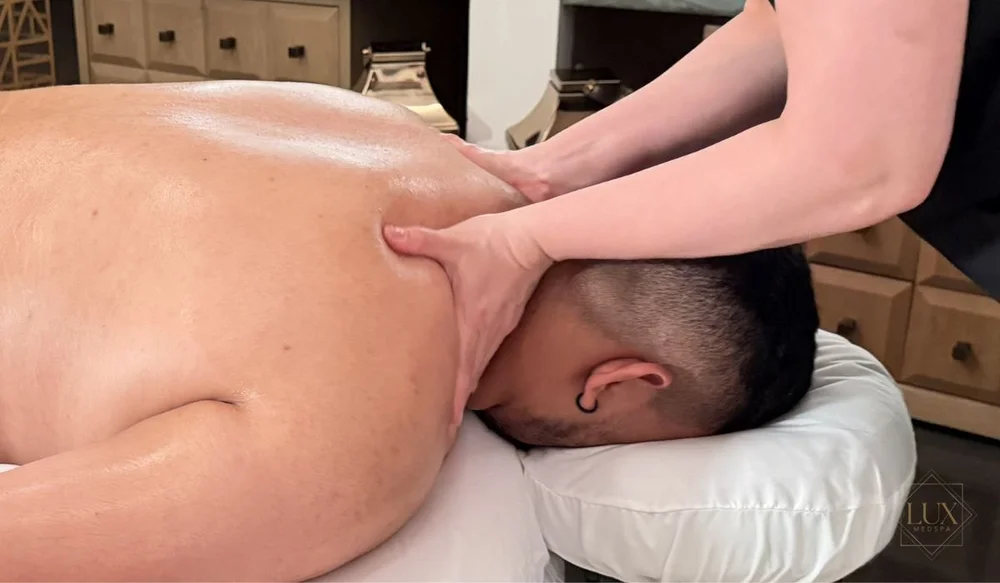
Nutrition and biochemistry are only half the picture. Circulation is also a mechanical process, and this is where professional massage therapy earns its place in a wellness routine — not as a medical treatment, but as a complementary practice with real physiological effects.
Understanding Venous Return
Venous return is the rate at which deoxygenated blood travels back to the heart. The more efficiently that happens, the faster the body clears metabolic waste from tissue and the more oxygen-rich blood gets recirculated to working muscles. Skilled massage therapists use targeted, directional pressure — moving toward the heart — to physically assist this process.
A study comparing conventional massage therapy to matrix rhythm therapy measured this effect directly using Doppler ultrasound on the lower limbs, finding that massage produced a measurable acute increase in popliteal artery blood flow, blood velocity, and artery diameter immediately following treatment.3 While researchers note that massage's benefits go beyond simple "increased blood flow" — mood, pain modulation, and tissue temperature all play supporting roles — the mechanical circulatory effect is well documented in the literature.
How Targeted Techniques Support Circulation
- Increased vasodilation. Massage helps relax the smooth muscle lining blood vessels, allowing them to widen and carry a greater volume of blood.
- Reduced muscular tension. Improved local blood flow raises tissue temperature, which increases elasticity and allows tight muscle fibers to release.
- Support for recovery. Whether recovering from exercise or simply a demanding week, increased venous return helps deliver oxygen and nutrients where tissue needs them most.
- Nervous system support. Reduced muscular tension and pain allow the nervous system to shift out of a stress response, which is part of why a well-executed massage feels as calming as it is physically effective.
These effects tend to compound with regular sessions rather than a single visit. Just as one workout doesn't build cardiovascular fitness, one massage doesn't permanently resolve chronic tension or sluggish circulation — the benefit is cumulative, built through a consistent rhythm of sessions spaced appropriately for your body's needs and lifestyle demands.
The Techniques That Matter
Trained massage therapists rely on a handful of specific modalities to achieve these effects:
- Effleurage — long, firm strokes applied in the direction of the heart to encourage venous return and ease surface tension.
- Deep strokes — firmer, targeted pressure that reaches deeper vascular tissue and elevates local muscle temperature.
- Lymphatic drainage — precise, directional strokes that help clear excess fluid and support the body's natural drainage pathways.
An important note: massage should never be treated as a medical intervention for cardiovascular disease, and it should always be performed by a licensed professional. Trained therapists complete formal education, pass licensing examinations, and understand the anatomy involved — which matters especially for clients with fragile veins or vascular sensitivities that call for careful, individualized pressure.
Why This Matters in Miami's Climate
Heat and humidity change how the body manages circulation day to day. In warmer climates, blood vessels near the skin's surface widen to help release heat, which can leave less blood pressure available to push fluid efficiently back toward the heart — one reason many Miami clients notice more swelling in the ankles and feet during summer months, or after long-haul travel. Regular massage, paired with hydration and movement, gives the venous system a mechanical assist that heat alone tends to work against. It's a small but meaningful reason circulation-focused bodywork tends to be requested more often locally than in cooler regions.
Building the Foundation of Flow
The Fundamentals Still Do the Heavy Lifting
The most important lesson in cardiovascular wellness is that the body works as one integrated system. Circulation isn't dependent on a single ingredient — it depends on your heart, vessels, muscles, hydration, nutrition, sleep, and daily movement working together. The strongest evidence for supporting healthy circulation continues to point toward the fundamentals: regular movement, a diet rich in fruits and vegetables, consistent hydration, quality sleep, and active stress management.
Exercise, in particular, does mechanically for the whole body what massage does more locally: contracting muscles, especially in the legs, act as a secondary pump that pushes venous blood back toward the heart against gravity. Hydration keeps blood at a viscosity your heart doesn't have to work overtime to circulate. Sleep gives the cardiovascular system its recovery window, when blood pressure naturally dips and vascular tissue repairs. None of these pillars is optional, and none of them can be substituted by a capsule, however well-researched.
Within that foundation, targeted supplements like beetroot or L-arginine — and complementary therapies like professional massage — can offer meaningful additional support. For Miami clients exploring these options as part of a broader wellness routine, the research is clear: proactive, consistent habits will always outperform any single shortcut.
If you take one thing from the research above, let it be this: circulation rewards consistency, not intensity. A single beetroot shot or one deep-tissue session will not undo months of sedentary habits, just as no single targeted massage will replace a broader commitment to movement and hydration. But layered together — daily movement, mindful nutrition, and periodic, professional bodywork — these habits compound. That compounding effect is what separates people who manage their cardiovascular health proactively from those who only address it once something has already gone wrong.
Experience the circulatory benefits of expert, directional massage in Brickell.
Explore Massage Services at Lux MedSpa Brickell (opens massage services page)Sources
- Benjamim CJR, Porto AA, Valenti VE, et al. "Nitrate Derived From Beetroot Juice Lowers Blood Pressure in Patients With Arterial Hypertension: A Systematic Review and Meta-Analysis." Frontiers in Nutrition, 2022. View on PubMed (opens in a new tab)
- Lerman A, Burnett JC, Higano ST, et al. "Long-Term L-Arginine Supplementation Improves Small-Vessel Coronary Endothelial Function in Humans." Circulation, American Heart Association, 1998. View on AHA Journals (opens in a new tab)
- Küçükşen S, et al. "Implementation of Matrix Rhythm Therapy and Conventional Massage in Young Females and Comparison of Their Acute Effects on Circulation." National Library of Medicine, PMC. View on PubMed Central (opens in a new tab)
Frequently Asked Questions
Is massage good for poor circulation?
Yes. Directional techniques applied toward the heart mechanically support venous return, the process that moves blood back to the heart. This is why professional massage is often used as a complementary practice for circulation, alongside daily movement, hydration, and rest.
What massage is best for blood circulation?
Swedish massage uses gentle-to-moderate gliding strokes (effleurage) that raise skin temperature and encourage blood and lymph flow, making it a strong first choice for general circulation. Deep tissue massage, using firmer petrissage strokes, is better suited for releasing deeper muscle restrictions that can restrict blood flow.
Does massage help circulation in the legs and feet?
Yes. Because gravity works against venous return in the lower body, directional strokes moving up the leg toward the heart are especially effective there. Clients who spend long hours standing, sitting, or traveling often notice the most benefit in this area.
What should you avoid if you have poor circulation?
Avoid prolonged sitting or standing without movement breaks, tight or restrictive clothing around the legs, extended exposure to heat without hydration, and smoking, which constricts blood vessels. If you have diagnosed poor circulation, consult a physician before beginning any new massage or exercise routine.
What parts of the body should not be massaged?
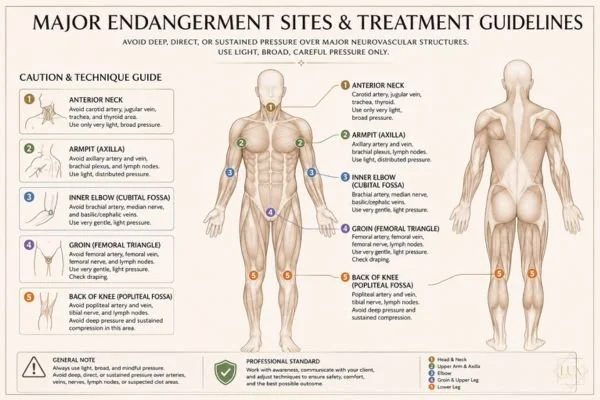
There are certain areas of the body known as endangerment sites. These are regions where major nerves, arteries, veins, lymph nodes, or other sensitive structures are closer to the surface and have less protective soft tissue. They are not always “no-touch” zones, but they require careful professional judgment and should never receive deep, direct, or sustained pressure.
The most common massage endangerment sites include the anterior neck, where the carotid artery, jugular vein, trachea, and thyroid area are located; the armpit, or axilla, where the axillary artery and vein, brachial plexus, and lymph nodes are found; the inner elbow, or cubital fossa, where the brachial artery, median nerve, and superficial veins are located; the groin, or femoral triangle, where the femoral artery, femoral vein, femoral nerve, and lymph nodes are present; and the back of the knee, or popliteal fossa, where the popliteal artery and vein, tibial nerve, and lymph nodes are located.
Because improper pressure in these areas may create risk, massage should be performed by a licensed massage therapist who understands anatomy, circulation, contraindications, draping, and appropriate pressure techniques. A trained professional will avoid deep pressure over these structures and use only light, broad, careful pressure when working near them.
Can people with Ehlers-Danlos syndrome get massages?
Many people with Ehlers-Danlos syndrome do receive massage, though it requires a therapist experienced with hypermobile connective tissue and lighter, more controlled pressure to avoid overextending joints. If you have EDS, share your diagnosis with your therapist beforehand and consult your physician about what pressure and positioning are appropriate for you.
Does massage help with Sjögren's syndrome?
Massage isn't a treatment for Sjögren's syndrome itself, but it's sometimes used as a complementary therapy to ease the muscle tension and joint discomfort that can accompany the condition. Anyone with an autoimmune diagnosis should coordinate with their rheumatologist before adding massage to their care routine.
This information is educational and not a substitute for medical advice. Please consult your physician regarding any diagnosed condition.
