

St. Patrick’s Day Guide | Ireland vs UK by Alan
Wellness Tips Miami • Cultural Storytelling • Founder Perspective
A founder’s reflection on St. Patrick’s Day, the difference between Ireland, Great Britain, and the United Kingdom, and the unexpected connection between European history and the gold roads of Minas Gerais.
At Lux MedSpa Brickell, we believe true luxury is not only about how something looks or feels, but also about the story behind it. This piece brings together geography, history, founder memory, and cultural clarity in a way that is both educational and deeply personal.
St. Patrick’s Day, Two Islands, and a Founder’s Memory from Ouro Preto
Every year, St. Patrick’s Day arrives with a familiar wave of green. In the United States, it has become one of the most visible cultural celebrations of the year. From Chicago to New York to Miami, people wear green, gather with friends, and celebrate Irish heritage with energy and pride. Yet behind all the festivities, one confusion still appears again and again: many people use Ireland, England, Great Britain, and the United Kingdom as if they all mean the same thing.
They do not. And for me, that distinction is more than a technicality. It is a reminder that history becomes more meaningful when we understand the geography behind it. It is also a reminder that the world is more connected than most people realize.
As the founder of Lux MedSpa Brickell, I have always believed that education creates a deeper kind of experience. Luxury is elevated when it is informed. Beauty becomes more memorable when it is anchored in meaning. That is why I enjoy bringing history, culture, and personal reflection into the way I communicate. This story begins with St. Patrick’s Day, but it quickly travels across the Atlantic, into Brazil, and into one of the most emotionally powerful places from my childhood: Ouro Preto.
Ireland, Great Britain, and the United Kingdom: The Clear Explanation
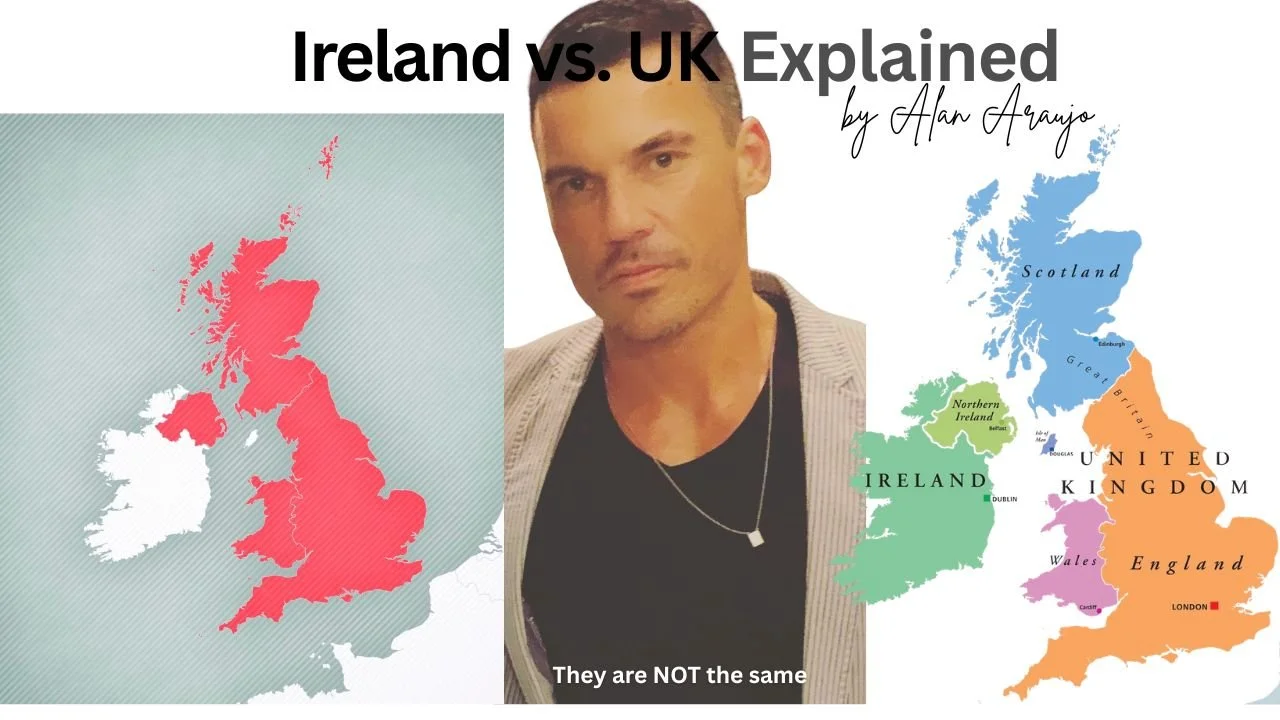
Let’s begin with the foundation. In this region of Europe, there are two main islands that matter for this discussion.
On the left is Ireland. On the right is Great Britain.
The island of Ireland is divided into two political entities: the Republic of Ireland, which is an independent country, and Northern Ireland, which is part of the United Kingdom.
The island of Great Britain contains three countries: England, Wales, and Scotland.
When you combine England, Wales, Scotland, and Northern Ireland, you get the United Kingdom. That is why the UK is made up of four countries. Its capital is London, which is located in England.
This is exactly why St. Patrick’s Day should be understood correctly. It is not an English holiday. It is an Irish celebration rooted in the cultural and spiritual history of Ireland, even though it is now celebrated globally and especially across the United States.
In an age of fast content, it is easy for nuance to disappear. But details matter. Ireland is not London. Ireland is not England. And the Republic of Ireland is not part of the United Kingdom. Once you understand that, the celebration of St. Patrick’s Day becomes richer because it is no longer just festive. It is grounded in identity.
Why This Subject Feels Personal to Me
My connection to this kind of history is not abstract. I grew up in Belo Horizonte, in the state of Minas Gerais, Brazil. Since I was around four years old, I often traveled through the historic region on the way to visit family. My aunt lived farther away, in Viçosa, and along those routes there was one place that always stayed with me: Ouro Preto.
Even as a child, I felt something unusual whenever we passed through that city. At that age, I could not explain it in words. It was almost like a quiet pressure in my chest, the sensation that a place could carry emotional weight. I did not yet understand architecture, colonial history, trade, or empire. I only knew that Ouro Preto felt different from anywhere else.
Later, when I began learning geography and history, those feelings made sense. Ouro Preto is one of those rare places that allows you to feel the past before you fully understand it. Its narrow streets, steep hills, preserved buildings, stone pathways, and baroque churches create a cityscape that seems almost suspended in time.
The streets are narrow because they were built for another rhythm of life. There were no cars. The movement of the city belonged to horses, walking, manual labor, and trade. The urban design feels European because it was deeply shaped by Portuguese colonial influence. And what fascinated me even more as I grew older was that the city had not lost that identity. It still carried the same visual language, the same gravity, the same quiet elegance of another era.
That early emotional relationship with Ouro Preto is part of how I learned to value places that are layered with meaning. It is also part of why I care so much about founder identity, legacy, and the stories that shape a brand. In many ways, that perspective still influences how I lead today, and it is part of the broader story shared on my About Alan Araujo page.
Ouro de Aluvião: The Gold That Was Visible to the Eye
One of the most important concepts in the history of Minas Gerais is ouro de aluvião, or alluvial gold. This refers to gold found in riverbeds, river margins, and surface sediments. In the early phase of Brazil’s gold cycle, there was so much gold in certain areas that people did not need deep excavation, advanced tools, or industrial machinery to find it.
The gold could often be collected through washing sediment and observing what was already present in the soil and near the water. That fact alone helps explain how rapidly some regions became rich and why cities like Ouro Preto became historically important. Wealth emerged quickly. Extraction was immediate. And the landscape itself became part of the economy.
When I think about this history, I am reminded that some of the most powerful moments in human development begin with what is visible long before it becomes structured. Gold seen at the river’s edge becomes a trade system. A preserved colonial town becomes a living classroom. A childhood route becomes a lifelong emotional reference point.
Over time, of course, the easiest deposits diminished. Mining became deeper, more labor-intensive, and more complex. But that first moment of abundance is what shaped the imagination of the region and left such a profound mark on the history of Minas Gerais.
From Minas Gerais to Portugal: How Wealth Traveled
Brazil was a colony of Portugal, so much of the gold extracted in Minas Gerais did not remain in Brazil. It flowed outward. It crossed the Atlantic. It entered Portuguese economic and religious life in visible ways, especially in architecture and church design.
This is why so many people immediately think of the extraordinary gilded churches of Portugal when discussing Brazilian gold. One frequently cited example is the Church of São Francisco, whose opulent gold interior has become symbolic of that era. The relationship between Brazilian extraction and Portuguese ornamentation is not merely decorative. It is a reflection of colonial economics, religious patronage, and the redistribution of wealth through empire.
It is important to say this with precision: Brazilian gold did not single-handedly create the Industrial Revolution. That would be an oversimplification. Britain’s industrial rise came from a more complex combination of coal, iron, labor shifts, mechanical innovation, and trade expansion.
But it is also fair to say that Brazilian gold contributed to the wider European economy during a period of imperial expansion. Through trade relationships, capital circulation, and colonial extraction, this wealth became part of a broader historical environment in which European powers intensified commerce and consolidated influence.
In other words, the history of Ouro Preto does not sit apart from European history. It is woven into it.
Why St. Patrick’s Day Is the Perfect Moment to Talk About This
St. Patrick’s Day gives us a unique opportunity to talk about memory, migration, and identity. What began in Ireland became one of the most recognized celebrations in America because culture travels. It adapts, expands, and takes root in new places without losing its origin.
That same idea applies to history. Geography is not static. It becomes meaningful through movement: people moving, goods moving, ideas moving, wealth moving. Ireland’s story traveled into the United States through immigration. Brazil’s gold traveled into Europe through colonial extraction. Great Britain’s influence expanded through industrial and imperial networks. These stories are not isolated chapters. They are part of the same global narrative.
That is what makes this subject so fascinating to me. A celebration can lead to a map. A map can lead to a memory. A memory can lead to a fuller understanding of how the world was built.
A Founder’s Perspective on Meaning, Legacy, and Experience
As a founder, I have learned that people remember what makes them feel something. They remember places with soul. They remember conversations that teach them something real. They remember experiences that are designed with intention.
That philosophy has shaped the evolution of Lux MedSpa Brickell and is reflected in our story, our standards, and the way we continue to build trust through service, consistency, and care. It is also why founder-led storytelling matters. A brand becomes more powerful when people understand the person, the values, and the lived experiences behind it.
For those who want to explore more about our journey, I invite you to visit our About Us page and our Press Hub, where our growth, recognition, and brand story come together in a broader context.
In a world driven by speed, I believe there is something deeply valuable in slowing down long enough to understand the why behind things. Why a city feels sacred. Why a holiday matters. Why a founder’s memory can become part of a brand’s identity. Why history still lives in the present.
Final Reflection
If there is one takeaway I hope readers remember, it is this: there are two main islands in this story, Ireland and Great Britain, and understanding the difference between them opens the door to a much larger conversation.
It opens the door to Irish identity, to the structure of the United Kingdom, to the legacy of migration in America, and to the flow of wealth and influence between Brazil and Europe. It also opens the door to something more personal: the idea that a child passing through a historic city can carry that feeling for life, and one day return to it with gratitude, understanding, and words.
For me, Ouro Preto was never just a stop along the way. It was an early lesson in emotional geography. It taught me that places can hold memory before we know how to explain it. And perhaps that is the best reason to keep learning history: not only to know the facts, but to recognize the invisible threads that connect identity, place, and human experience.
Continue Exploring Lux MedSpa Brickell
Discover the founder story, brand journey, and elevated wellness experience behind Lux MedSpa Brickell.
Frequently Asked Questions
What is the difference between Great Britain and the United Kingdom?
Great Britain is the island that contains England, Scotland, and Wales. The United Kingdom includes those three countries plus Northern Ireland.
Is the Republic of Ireland part of the UK?
No. The Republic of Ireland is an independent country. Only Northern Ireland is part of the United Kingdom.
Why is St. Patrick’s Day associated with Ireland and not England?
St. Patrick’s Day is rooted in Irish religious and cultural history. It celebrates Saint Patrick and Irish heritage, even though it is widely observed in the United States and many other countries.
What does ouro de aluvião mean?
Ouro de aluvião means alluvial gold, or gold found in riverbeds and surface sediments. In the early gold cycle of Minas Gerais, it was abundant enough to be collected without deep excavation.
Why is Ouro Preto historically important?
Ouro Preto became one of the most important cities in colonial Brazil because of its connection to gold extraction, Portuguese colonial architecture, and the broader economic history linking Brazil to Europe.
