

Retinol vs Retin-A in Miami Summer: What You Need to Know
Beyond the Surface: Why Miami Summers Demand a Smarter Vitamin A Strategy
Retinol, Retin-A, and retinoids are not interchangeable. In Miami, where UV exposure, heat, humidity, and visible light are constant variables, understanding the difference is essential for safer, smarter skincare.
If there is one skincare category that gets oversimplified online, it is Vitamin A. In South Florida, that confusion becomes expensive. One person is told to start a retinol because it is “gentle.” Another is given prescription tretinoin because it is “stronger.” Someone else is layering active serums, skipping reapplication of SPF, and then wondering why their skin suddenly feels tight, reactive, darker, or uneven by mid-summer.
The truth is this: retinoids, retinol, and Retin-A do not mean the same thing. Once you understand the hierarchy, the biology, and the role sunscreen plays in a city like Miami, your routine becomes more strategic. That is exactly how we approach skin at Lux MedSpa Brickell with Alan Araujo (opens in a new tab): results, without unnecessary trauma.
First: what is a retinoid?
Retinoids are the full family of Vitamin A derivatives used in skincare and dermatology. They are studied for acne, texture, photoaging, fine lines, and pigment irregularities. Within that family, the two names people confuse most are retinol and tretinoin.
Retin-A is a brand name historically associated with tretinoin, which is a prescription retinoid. Tretinoin is already in the active form your skin can use. That is why it tends to work faster and more aggressively. It is also why it is more likely to trigger dryness, peeling, redness, and barrier stress if used without a proper transition strategy.
Retinol, by contrast, is an over-the-counter form of Vitamin A. It has to go through conversion steps in the skin before it becomes retinoic acid. That usually makes it slower, more approachable, and often easier to tolerate. But “easier” does not automatically mean “careless.” In Miami, even a softer Vitamin A strategy still has to be paired with sun discipline.
What Vitamin A is actually doing to the skin
The reason retinoids are so respected is because they help skin behave more efficiently. They accelerate cell turnover, help improve the look of uneven tone, support smoother texture, and are among the most established ingredients for visible photoaging. They are not hype ingredients. They are functional ingredients.
But there is an important nuance here. Vitamin A does not mean your skin suddenly becomes better protected. In real life, especially in the beginning, retinoids can leave skin more reactive if the barrier is not supported. This is where many people make the wrong assumption. They focus only on correction and forget defense.
Melanin is part of your skin’s protective response to ultraviolet exposure. That beautiful tan people chase is not a sign of “healthy sun.” It is your skin responding to UV stress. So when you combine active Vitamin A use with inconsistent sun protection, you create the ideal setup for irritation, rebound pigmentation, and a routine that feels like it stopped working.
Why Miami changes the conversation
In Miami, summer is not just a date on the calendar. It is a skin condition. UV is strong, humidity is high, heat increases exposure behaviors, and people are outside more often even when they think they are “not in direct sun.” Add balconies, pool decks, bright reflected light, driving, walking Brickell, and outdoor dining, and the environment becomes part of your skincare formula.
That is also why cloudy days are so deceptive. Cloud cover does not eliminate risk. That is one reason I have been speaking so much lately about sunscreen awareness: the sun you do not feel is often the sun you underestimate.
This is where many people on tretinoin or traditional retinol routines get into trouble. They are trying to improve pigment while quietly feeding the exact conditions that worsen it. They are renewing the skin at night, then under-protecting it in the morning. The product is not always the problem. The routine around it is.
The COSMEDIX difference: why formulation matters
At Lux MedSpa Brickell, we do not choose products by marketing noise or raw percentage claims. We choose based on formulation behavior. That is one reason I continue to work with COSMEDIX.
COSMEDIX is known for its chirally corrected positioning and for taking a more controlled, skin-intelligent approach to active ingredients. In practical terms, that matters because the goal is not simply to “use more Vitamin A.” The goal is to help the skin benefit from Vitamin A without provoking unnecessary irritation.
Their proprietary LG-Retinex technology is a major part of that philosophy. Rather than relying on a basic retinol story, COSMEDIX uses an encapsulated approach that combines retinol and retinal in a delivery system designed for penetration, stability, and improved tolerance. This is one reason products like Serum 16 and Serum 24 are useful in professional skincare conversations: they give us a more elegant way to work with Vitamin A, especially for clients who want visible refinement without the harsh learning curve often associated with prescription-first routines.
Summer pivot: correction at night, defense in the morning
If your skin tolerates Vitamin A well, summer does not always require panic. It requires a pivot.
At night, you may continue with a carefully chosen Vitamin A formula. During the day, your focus must shift heavily toward defense: antioxidants, barrier support, and a serious broad-spectrum SPF. That is where a product like Peptide Rich Defense SPF 50 (opens in a new tab) becomes very relevant. The goal is not just to wear sunscreen. The goal is to wear a sunscreen you will actually enjoy using consistently in Miami heat.
This is also why your summer routine should not rely on makeup SPF alone. And it should definitely not rely on cloudy weather as your protection plan. In Miami, sunscreen is not the final step you remember when convenient. It is the foundation that makes every active ingredient safer and smarter.
So what should you actually do?
Start by respecting the difference between prescription and professional skincare. Prescription tretinoin has a place. Retinol has a place. Encapsulated professional systems have a place. But they do not all belong to the same client, in the same season, at the same strength, with the same barrier condition.
If your skin is already showing inflammation, increased darkness, stinging, or chronic tightness, do not interpret that as proof that the routine is “working harder.” It may be proof that the skin is asking for a smarter plan.
That is where a customized protocol matters. Sometimes that means stepping down. Sometimes it means switching format. Sometimes it means keeping the active and radically upgrading the morning defense layer. And often, especially in Miami, it means combining home care with custom facials designed for your current skin condition (opens in a new tab) rather than your idealized routine from six months ago.
Intelligent skin is not built through intensity alone. It is built through timing, formulation, consistency, and context. That is how we approach skincare at Lux MedSpa Brickell (opens in a new tab): not by chasing reactions, but by creating results.
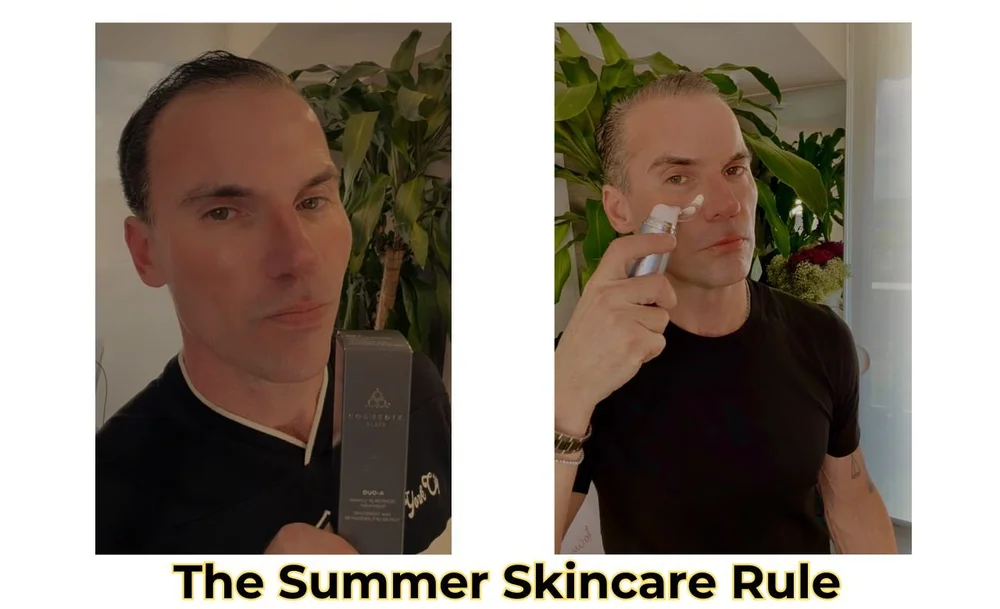
In the end, the real summer rule is simple: do not separate Vitamin A from sunscreen. One without the other is incomplete. And in Miami, incomplete routines always reveal themselves.
Ready to transition your routine for the season?
Shop our curated COSMEDIX essentials, explore a daily light weight SPF that feels elegant in Miami weather.
Frequently Asked Questions
What is the difference between retinoids, retinol, and Retin-A?
Retinoids are the full Vitamin A family. Retinol is the over-the-counter version that needs to be converted by the skin before it becomes active. Retin-A refers to tretinoin, a prescription form that is already active and generally stronger, faster, and more irritating if introduced too aggressively.
Can I use retinol in the summer in Miami?
Yes, but summer requires a smarter strategy. If your skin tolerates Vitamin A well, the key is pairing it with barrier support, antioxidants, and diligent broad-spectrum SPF every morning. In Miami, sunscreen is not optional when using retinol-based products.
Why can pigmentation get worse when using Vitamin A incorrectly?
Vitamin A can be very helpful for uneven tone, but irritation plus under-protected sun exposure can worsen pigment-prone skin. When the barrier becomes inflamed and UV exposure is not controlled, skin may respond with more visible discoloration instead of a clearer result.
What makes LG-Retinex different from basic retinol?
COSMEDIX positions LG-Retinex as an encapsulated Vitamin A technology that combines retinol and retinal to improve delivery, stability, and tolerability. For many clients, that means a more elegant professional approach to renewal than harsher, more reactive retinol experiences.
Is sunscreen still necessary on cloudy Miami days?
Absolutely. Cloud cover does not remove UV risk. Cloudy weather can create a false sense of safety, which is exactly why many people under-apply or skip SPF when they should be most consistent.
